A: Introduction
The
issue of land litigation clogging our courts is an age-old canker.
According
to the Judicial Service’s “Analysis of Civil Cases & Criminal Offences for
2022/2023 Legal Year” Report, land cases continued to have a significant
caseload with 3,744 new cases filed. However, the resolution rate was
approximately 16.23%, indicating that a substantial number of cases were still
pending at the end of the year. This backlog was attributed to complex land
tenure system and inefficient land administration regulators.
B: The Jahori land case
The
recent High Court case titled Bolewura
Sarfo Kutuge Feso I (Suing for himself and on behalf of the descendants of
Ndewura Jakpa within the Bole Traditional Area) v Fuseina Nungbaso & Others
Suit No. NR/TL/HC/W1/12/24[1] in which judgment was
given on 23rd July, 2025 by Mr. Justice Richard Mac Mogyapwah,
(Justice of the Court of Appeal sitting as an Additional High Court Judge) has
further brought to light the canker of fruitless land cases filed in court.
These cases waste the courts’ precious time and resources.
In
the Bolewura Sarfo Kutuge Feso I case,
the Bolewura (plaintiff) sued Fuseina Nungbaso and two other persons (defendants)
for on order to declare about 9,200 square kilometres of land in the Bole
Traditional Area as belonging to the descendants of Ndewura Jakpa, the founder
of Gonja Kingdom. The defendants also counterclaimed that the land in dispute,
known as ‘Jahori’ land, is ‘clan land’ that belongs to the Jahori Clan of the
Gonja Kingdom. Therefore, it is not ‘skin land’ belonging to the Bole skin.
The
issue the High Court had to decide was whether Jahori land was for the Bole
Skin or the Jahori Clan.
The
learned Judge opened his judgment with a beautiful introductory piece as
follows:
“In
the intricate tapestry of land ownership in Ghana, title is not always written
on parchment or evidenced by a deed, but often preserved in the collective
memory of a people, passed down through generations by word of mouth, custom,
and ritual. Where formal documentation is absent, it is traditional evidence
that breathes life into a claim for title - a form of proof that, though
unwritten, is deeply rooted in the conscience of the community. This case presents a very interesting analyses that attempts
to venture into the history and foundation of the Gonja Kingdom. This judgment
shall explore the legal principles governing the declaration of title to land,
with particular emphasis on the probative value and evidentiary weight of
traditional evidence in establishing ownership.”
True
to the outline set out in the introduction, the High Court gave a masterful and
comprehensive judgment that traced the traditional history of Gonja lands and
the respective skin and family or clan lands in the area. The Court also
discussed in detail the principles by which a party seeking an order of
declaration of title to land must prove title. It emerged that in an earlier
2021 case, the defendants had been adjudged as the owners of Jahori clan lands.
In the end, the Court held that the Bolewura failed to prove his case (on the
balance of probabilities) that Jahori lands were Bole skin land. The Bolewura
lost the case and Jahori lands were adjudged as clan land.
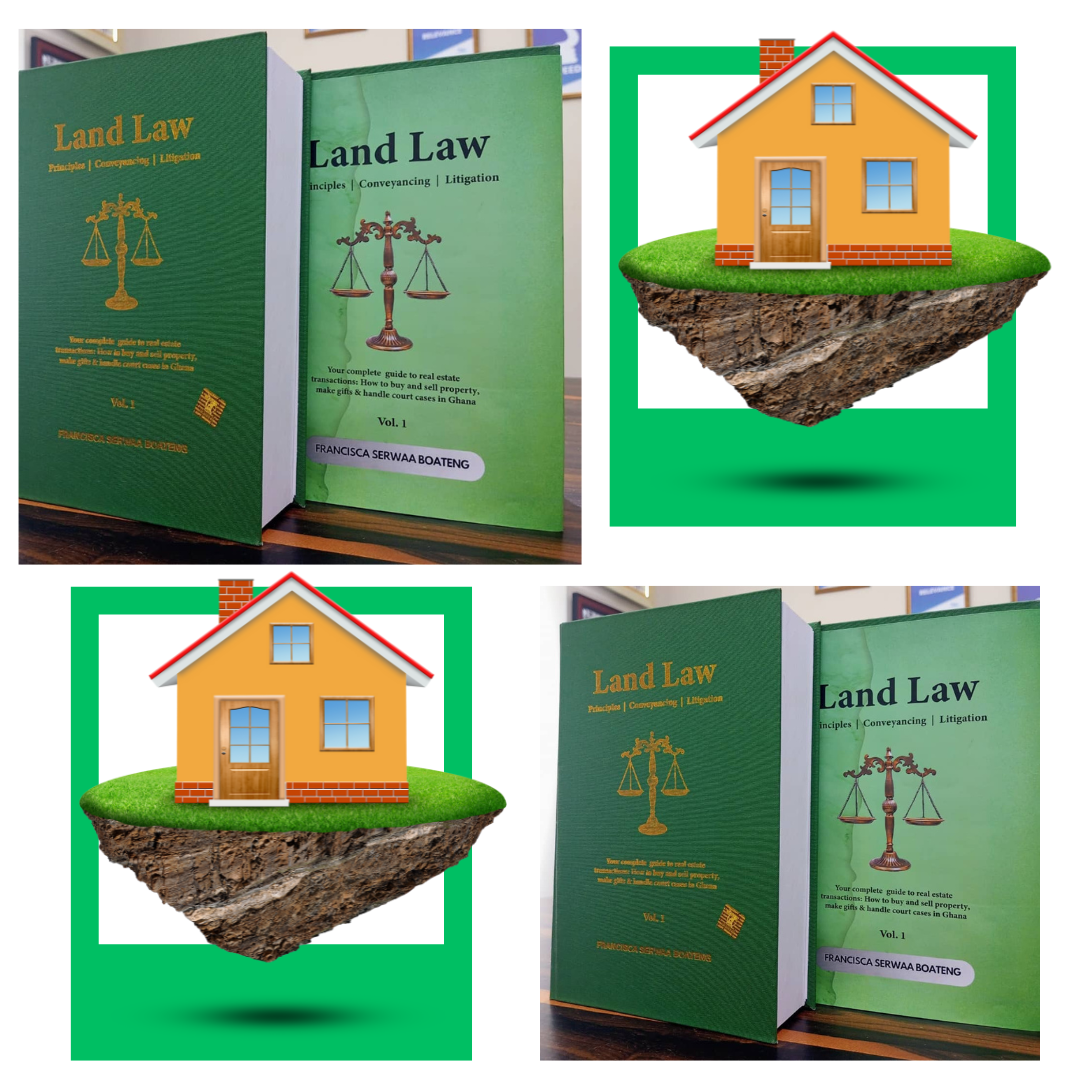
In
my latest book, LAND LAW: Principles,
Conveyancing & Litigation (Vol.
1) (2025), I discuss ‘Stool/Skin and Clan land’ in Chapter 3. Topics
discussed include the following:
Stool/Skin
Land
• Stool/skin
land defined
• Origin/derivation
of stool/skin land
• Competence
to grant stool/skin lands.
• Persons
who can grant/sell stool/skin lands
• The
birth of the Head of Family (Accountability) Law
• The
need for accountability by stool/skin occupants and customary land caretakers
• Stool/skin
occupants accountability provisions in the Land Act, 2020: A new dawn
• Who
is a “chief”?
• The
concept of ‘stool/skin property’ under the Chieftaincy Act
• Governmental
oversight of sale of stool/skin lands
a) Office
of the Administrator of Stool Lands
• The
Legal Effect of the Land Act in the Context of Articles 257, 258 & 267 (1)
of the Constitution, 1992
• Vesting
& De-vesting of Stool Lands
a) Background:
Vested lands
b) Vesting
of stool or skin, or clan or family land
c) Management
of vested lands
d) De-vesting
of vested lands
Clan
Land
• What
is a “clan”?
• Clan
land defined
• Clan
lands in Ewe-speaking areas
• Clan
land among the Akan
• Vesting
of clan land
Chapter
18 discusses actions for declaration of title to land and touches on topics
such as the following:
• Plaintiff
to rely on the strength of his/her own case
• Burden
of persuasion
Chapter
20 talks about pleadings
and proof in land litigation. It covers the following topics in detail:
PLEADINGS
• Statement
of claim
a)
Drafting the statement of claim
• Judgment
in default of appearance
b)
Default judgment in a claim for possession of
immovable property only
c)
Setting aside judgment in default of
appearance
d)
Default of appearance in moneylenders and
mortgage actions
• Statement
of defence
a)
Judgment in default of defence
b)
Setting aside judgment in default of defence
c)
Default of defence in moneylenders and
mortgage actions
• Need
for defendant to counterclaim in certain cases
• Reply
and defence to counterclaim
a) Default of defence to counterclaim
• Preparation
for trial
a) Application
for directions
b) Filing
of witness statement and pre-trial checklist
c) Case
management conference
PROOF
• Burden
of proof
a)
Burden of persuasion
b)
Burden of producing evidence
• Standard
of Proof – Balance of Probabilities
• Evidence
required to meet standard of proof in land cases
• No
witness? No problem
• Undenied
averments
• Corroboration
• Proof
in acquisition cases
• Identity
of the land and its boundaries
a) A
court cannot demarcate the boundaries for the parties
b) Site
plans
c) Composite
plan
d) Filing
of survey instructions
• Reliance
on traditional or family history as evidence
• Proof
of fraud in land cases
a) Standard
of proof
• Reliance
on written documents as evidence
a) Written
document vs oral evidence
b) Old/ancient
documents
c) Plea
of non est factum
• Stamping
of documents intended to be tendered in evidence
a) Practice
regime for tendering documents chargeable with stamp duty
• Competent
witness & admissibility of evidence
a)
Competent witness
b)
Credibility of witnesses
• Expert
evidence
a) Who
qualifies as a court expert
b) Report
of court expert
c) Court
not bound by expert opinion
d) Cross-examination
of court expert
e) Fees
of court expert
f) Calling
of expert to give evidence
g) Admissibility
of evidence
• Claim
against a dead person’s estate
• Death
or bankruptcy of party while case is pending
a) Death
of sole plaintiff or defendant
b) Bankruptcy
of sole plaintiff or defendant
c) Application
for order of substitution after death or bankruptcy
d) Discharge
or variation of the order for substitution
e) Effect
of the order of substitution
f) Failure
to proceed after death
C: Conclusion
The
moral of the story is that, persons who intend to sue or are sued in land
cases; and the lawyers who represent persons in land litigation – as well as
the judges who sit on such cases - must always be abreast with the law. This
will help reduce the number of land cases waiting impatiently on Cause Lists
for years.
[1] Credit
for copy of the judgment goes to The Law Platform. The full case is available
at https://www.thelawplatform.online/post/bolewura-loses-land-case-of-9000km-of-jahori-lands-jahori-clan-declared-rightful-owners.
The trial judge is highly commended for his comprehensive, well-researched and
well-balanced judgment.